The idea is never the problem
My interview with John Scalzi from the Green Mountain Book Festival
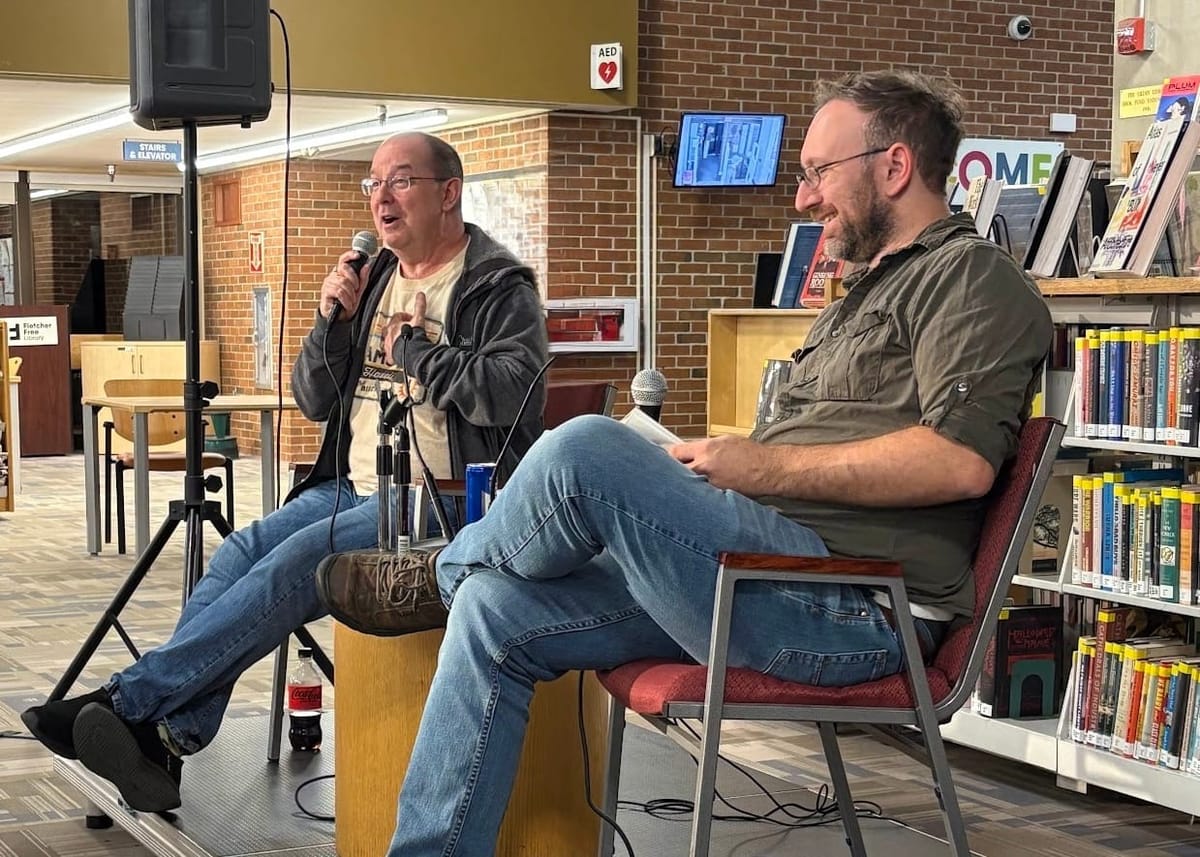
In September, John Scalzi was the headliner of the Green Mountain Book Festival in Burlington, Vermont. It was a great day: this fall's festival was all about science fiction, and we had a great group of Vermont authors who joined us: Craig Alanson, William Alexander, M.T. Anderson, Emily Hamilton, Margot Harrison, Mike Luoma, and Brian Staveley, for a couple of panels to talk about the craft of writing genre fiction.
I've interviewed Scalzi on a couple of occasions, and as part of the festival's day of programming, I sat down with Scalzi at the Fletcher Free Library to interview him about his career, writing, science fiction, and quite a bit more. It was a fun conversation, and you can watch the video of the interview here, and I've transcribed it below for your reading pleasure.
Scalzi has been publishing science fiction for more than two decades. He self-published his first two novels on his long-running blog Whatever, and from there, released his traditionally-published debut, Old Man's War with Tor Books in 2005. Since then, he's published nearly 20 novels and a number of shorter works, including Redshirts, The Kaiju Preservation Society, Starter Villain, and most recently, When the Moon Hits Your Eye and The Shattering Peace.
 Andrew Liptak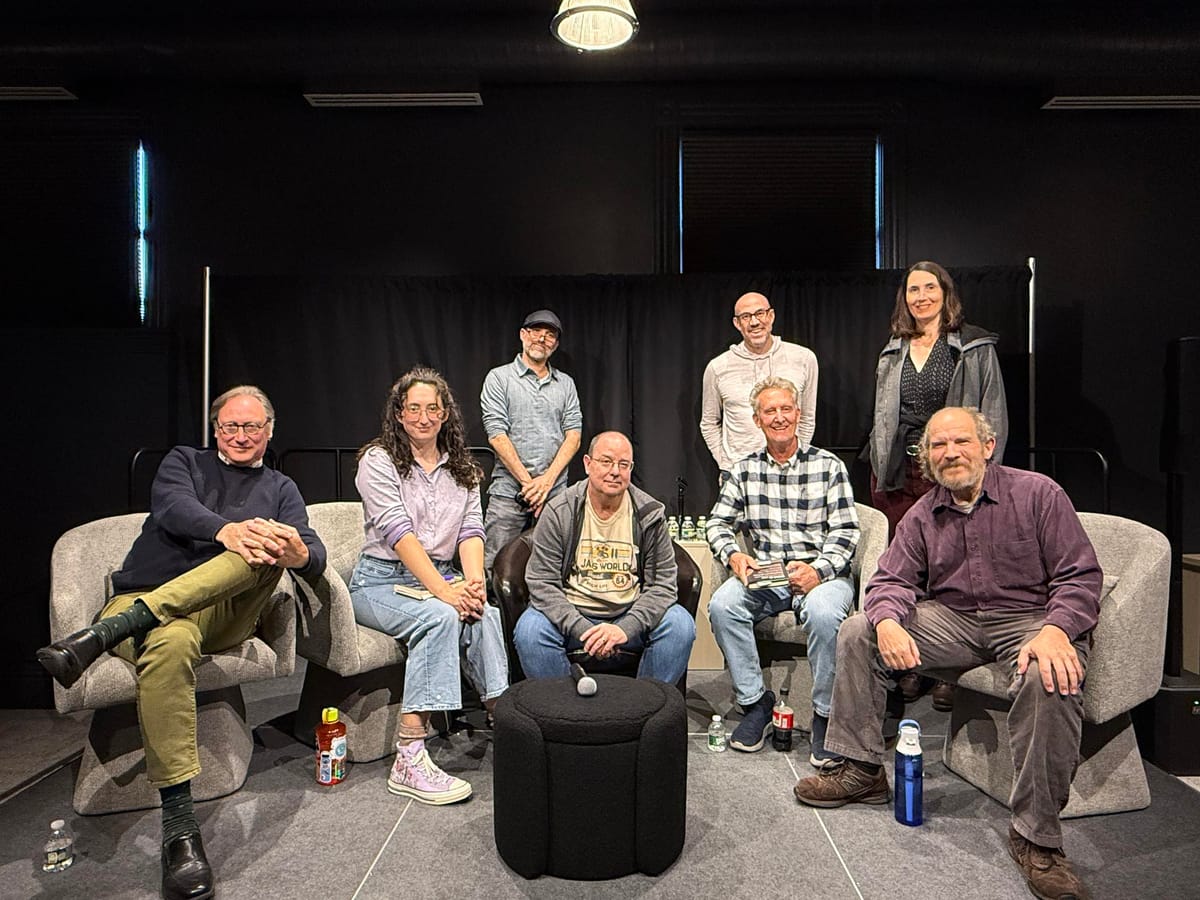
I'll note that it's not an exact version: I've edited down the ums and uhs and repeated words to make it a bit more readable, and worked to keep the voice and tone that that the interview took. I've used italics to note where he's emphasized a word in a particular way or <> to indicate a funny tone or noise one of us makes.
Here's my conversation with John Scalzi:
First of all, thank you very much for coming to Vermont, we appreciate it.
You're welcome. I was in San Francisco yesterday. That was quite a journey. I got in last night, I went to Al's Fries, and then went to sleep at 8:30. So clearly, I have experienced the Burlington nightlife as it is meant to be experienced.
So you haven't had your maple syrup shot yet.
I have not – I told people I went to Al's, and they were like "did you have the maple creemee?" And I'm like, "No." And they're like sigh and I'm like, "guys, come on. I just got in. I don't know all the things yet." I know there's Champy, right?
Champ.
I went to the lake and he did not show up. I was a little angry about that. I was like, "I made the effort. Where's my crypted?" Did not arrive. I'm a little bitter, but I did see somebody with Champy on their hat. It was all very good.
I'm sorry, I'm just like this. I don't know what he's going to ask, but I'm a little wired right now, so just be ready.

I've been soliciting some questions from friends and readers and the first question I have is: how dare you?
That is fair, and I think that probably relates to my tendency to make you care about characters and then just get them out of the way. I think that is one of the things that I do quite a lot, not to the same extent as George R.R. Martin does, but who does that? Nobody does it like George does.
I have a daughter who would not read most of my stuff when she was growing up because it was weird to read the books and these characters knowing that they came out of your dad's brain.
There was a book I wrote with her mind called Zoe's Tale. She had never read it, and while I was on book tour (I think this was 2014 or 2015) I didn't know she was reading it until I got this all caps, outraged text that said, "How could you do that to Enzo?" and I don't know if you know what happens to Enzo, but nothing good. And so I was like, "Oh, so this is how my I find out that my daughter has in fact read this book" and secondly, she had joined the legion of people who are angry with me for what I have done to their favorite characters.
And the answer is why dare I? Becauuuuuusssssssse sometimes they gotta die. They just do. Sometimes that's where the story goes, and you're like, "oh, I love that character, but they got to die."
[To a large, captive audience] So, is anyone here a reader of Scalzi's books? <Laughter>
[To audience] Have you read my books? If you haven't read my books, why are you here? Is this a class assignment? Do you get a grade? Who's here for class? <laughter> Is there anybody who's here for a class assignment?
So we don't need to go through your entire backlog of of titles because that would take all night, but this year is the 20th anniversary of your breakout book, Old Man's War ...
My first traditionally published novel.
First traditionally published novel, yes, there's an asterisk there, actually.
What a great complication that is.
You initially self-published Old Man's War and now you've just released The Shattering Peace, which is the seventh book in the series. Have you been surprised by its longevity? 20 years is a long time.
Thank you. [laughter]
Tell us about your books, old man! Yes and no. The first is you have to understand that I didn't intend to be a novelist in the first place. I had started off in journalism and when I wrote Old Man's War, most of what I was doing was freelance, nonfiction writing. I was writing nonfiction books and I was doing work for financial services companies and tech companies and stuff like that.
So I had this whole other life as a writer. I wrote the novels and then Old Man's War sold to Tor in 2002 for the incredibly immense sum of $6,500. [laughter] Right, laugh now. I remember saying to Krissy, my wife, "look, what's going to happen is this will come out, it will do what it does, and then every three or four years, I will come out with another novel." I wasn't thinking like sequels, I just thought like different novels, and they'll come out and they'll pay me about the same, and then I'll go to these conventions and they'll be like, "Oh, yeah, yeah, yeah, you're that guy who wrote the thing, and that will be it."
 Andrew Liptak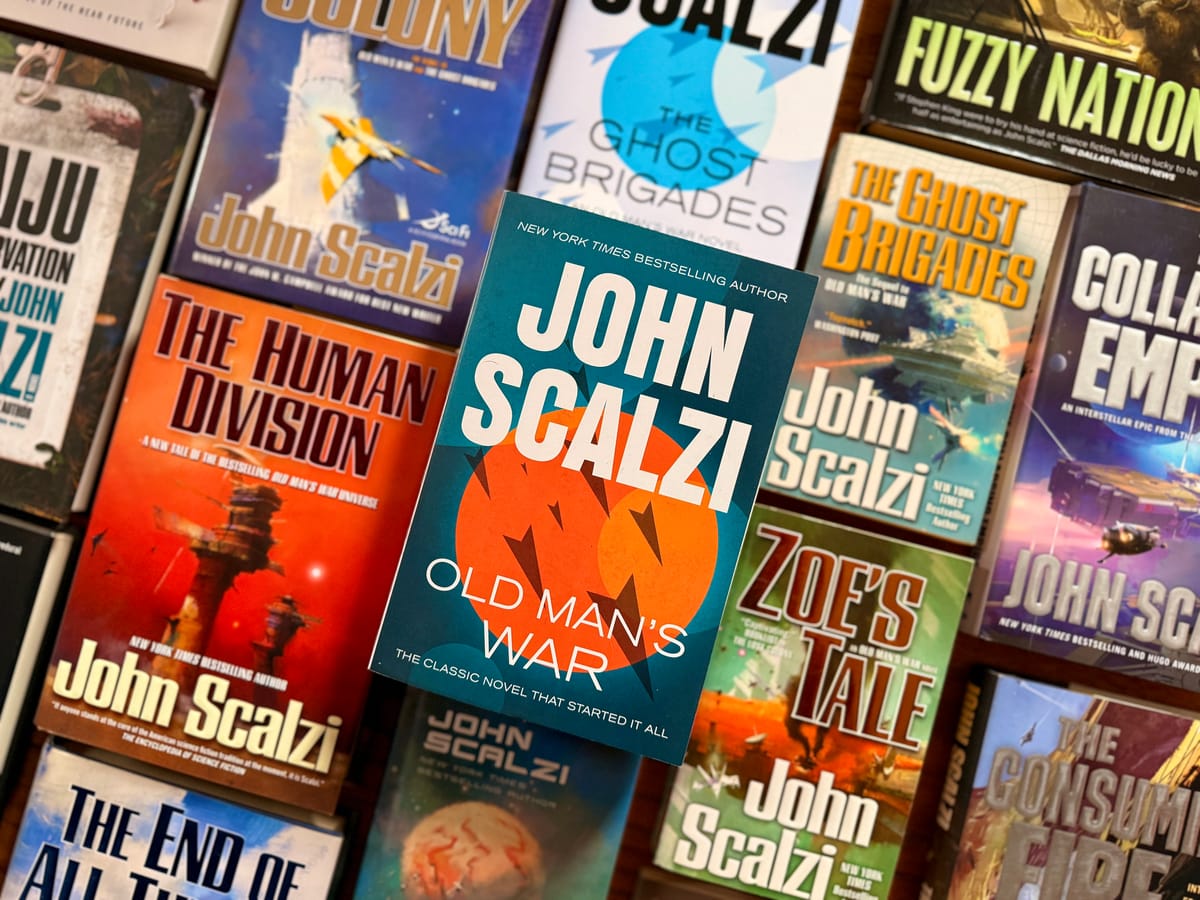
So, I wasn't I wasn't expecting to be a novelist, period. When Old Man's War took off and they were like, "you have to write more novels." And I was like, "Do I?" They're like, "yes, here's money," and I was like, "I guess I do." And then off we were to the races.
Now it's 20 years later and writing novels is what I do full-time. I did not expect to be in this position at all: you would have told 35 year-old me, "you'll be in Burlington in front of a room full of people." And I'm like, "What did I do? Are they judging me? Will there be tomatoes involved?"
That comes later.
That comes later. "Yes, now comes the pelting of the vegetables," as is tradition here in Burlington, and then Champy arrives.
So I didn't expect that at all. So the idea that 20 years later, not only would I actually be a novelist, but that the there would be a series of these books because Old Man's War just came out as a book. I wasn't expecting to do a series until tour came to me and said, "You made money for us. Make another." Okay. And just kept going. So, yeah, it's absolutely completely a surprise.
But having said that, Old Man's War is one of those weird books that sells exactly the same number of books every year it has been out, and a significantly large number, and that if all I ever did was Old Man's War, I would still be okay.
Because of that, and because then that means that the books in the series have also sold reasonably well, it is not a surprise that when I put out the seventh book for the 20th anniversary (which I did plan), that there was still interest in it and people were still excited about it. I am gratified that our prediction of "let's put out the book for the 20th anniversary, people will like that," [and] "let's repackage the old books in the series in trade paperback with with thematic stuff that puts them all together so people will want to collect them all" was also a pretty cool idea.
But ultimately, it goes back to no, this is all a surprise to me. [I] literally did not expect to be a novelist. It just happened, I just rolled with it, and now here I am in Burlington.

One of the interesting things over that 20 years, there's a perception of science fiction writers just sort of churning out installment after installment after installment. You haven't done that with with this series and you've actually spoken about how you've resisted that "every year, new adventures of the same characters." So how do you determine what the bar is for adding a new book to the series?
So this is a complicated question. The short answer is, I am in a fortunate place where I don't have to continue my series. I was – okay this is a first world problem for writers and particularly science fiction and fantasy writers – But we have this question and the question is, do my readers love me for me or do they love me for my series?
I see the other writers in the back going, "Yep, that's a thing," and what that means is if I put out a book that is not in my most famous series, are [readers] still going to buy it or are you just going to buy the things that are in my series and [so] when I put something else out, it sells at a quarter or a fifth or a tenth of whatever it is my most famous series is.
You wouldn't think that would matter because it's like you're getting paid, shut up, right? But it is a thing that we are concerned about. I have been very fortunate that in addition to the Old Man's War series, there have been other books that have other series that I've done that have been well received and that my standalone books like Starter Villain or Kaiju Preservation Society or When the Moon Hits Your Eye or Redshirts have done very well as well. So that means you like me for me, thank you.
But that also means that I don't have to come back to a series in order to eat, and that is actually very important. So when I finished the Old Man's War series with the now inaptly named The End of All Things, I was like "I'm done with it and maybe I'll come back to it if I can think of something, but if not, then I will just go off and do other things." I did the Interdependency series, I did another book in the Lock In series [Head On], I wrote all those standalones, and was going just fine.
But eventually my brain wanted to come back to that universe to tell another story and came up with a story it wanted to tell in it. That's when we were like "well, let's schedule that for the 20th anniversary, because you had the idea," but the important thing was I had the idea and it was a story that I wanted to tell so I didn't have to feel obliged to come back to that universe; I could come back when it was interesting to me.
This is a thing: Craig Alanson and I were talking on a previous panel and we were just talking about how fundamentally, writing means that we have to be interested in the things that we are writing. We have to be amused with them. We have to be interested. We have to be intrigued because if we are bored with what we are writing, oh boy, you are going to feel it, right?
So what that means for me with the series is do I feel obliged to come back to it or do I feel lucky that I get to come back to it? With The Shattering Peace, I felt very lucky to be able to come back to it when I did and in the manner I did.
 Andrew Liptak
Without going into spoilers for the book, what are the types of things that you have gotten you excited about returning to in this particular world?
Well, first off, the same amount of time has passed in that universe as has passed in the real world – 10 years. So that is more than enough time for plot ideas to ripen. If you think, "well, 10 years is not a lot of time," think about where we all were in 2015. What has happened since then? Oh, nothing. So that's one thing.
I like when I continue on in-universe to take a character that had been a supporting character or a side character and elevating them into the primary character. In this particular case, that was Gretchen Trillo, who had been a supporting character in Zoe's Tale, Zoe's best friend. I made them the main character because that allows for some continuity, while at the same time introducing a new story, characters, elements, and so on and so forth. That made me excited because I liked that character when I wrote her as a supporting character and to elevate her was cool to me.
I also like the idea that there's this unknowable alien species called the Consu, who're technologically advanced. In all the previous books they're like, "Oh shit, Consu." This time, you get to spend time with them and you're like, "they're idiots just like us," except they have better technology, because I thought that was actually important to do. And so all of those things made it exciting to me.
And there is the, and I won't lie that I knew that, like I was on tour for Starter Villain and people like, "what's coming up?" I was like, "well, the next book is going to be When the Moon Hits Your Eye and I'm going to turn the moon into cheese," and people like, "Okay, cool, well, that's Scalzi, that's very on brand for you." Then I would say, "and the book after that is going to be a new Old Man's War book." And they all went <gasp> and literally they just looked like that.
So the fact that people were so excited that there was an Old Man's War book coming out, I was like "this is my ace in the hole." If Moon flops, I'd be like "well, that didn't do great, but yada yada yada, here's this new Old Man's War book. Put it in your face."
The good news is Moon did just fine, and The Shattering Peace has done very well as well, so all of that was exciting and the fact that internally for me as a person and as a writer, this was exciting to go back to the universe that I knew anecdotally that the interest was still there, right? That you guys were still excited about the Old Man's War universe. That was actually really cool.
20 years is a long time in publishing – we're going to keep that going <laughter>
20 years is a long time period!
So when you first published Old Men's War, you serialized it on your blog, this newish thing.
Back when blogs were new! <laugh>
The publishing industry and technology has changed immensely, so what has been most consequential to you and your career when it come when to the actual publishing of books?
When I sold Old Man's War in 2002, to give you some context, blogs indeed were still a new thing, not unlike, BookTok might have been a year ago (because it's now on a decline, who knows what's coming after that?)
When I sold Old Man's War, eBooks didn't exist yet, audiobooks were a single shelf at the local bookstore and they were all Stephen King, John Grisham and Patricia Cornwall, right? So they weren't even a concern for us. And quite frankly, most of the science fiction writers still looked pretty much like me: straight white dude. It's a straight white dude genre.
Now it's 20 years later and here's what's happened: eBooks are now a huge part of sales. There's a reason why The New York Times has a combined print and eBook list now, as well as their hardcover [list].
Audiobooks are a huge part of my sales. Starter Villain sold 1:1 in audiobook versus print and eBooks. That's partly because Audible treats me very well: they made a TV ad for Starter Villain and I knew about that because my mother called me up and was like, "I saw an ad!" And I'm like, "Okay, thanks, mom."
So from that point of view, the opportunity to sell books has expanded immensely because some people wouldn't buy books, but they'll buy eBooks because they now they have space for them or they just prefer electronic. There's a whole audience that didn't read before they had audiobooks because they were commuting. The time that they would have spent reading was actually the time that they were in their car. They now read because they have audiobooks.
There was a stat that recently came out that said the amount that people read these days is down like 40%. And people are like, "what does that mean for literacy?" It means nothing for literacy. No one has fucking time anymore, right? Think of everybody who's worried about their jobs, they have to get second jobs, they have to do all the stuff with their families and everything else that they're doing.
Reading is a luxury item: you make time for it when you are done with everything else you do. And so all of a sudden you have audiobooks that co-occupy that time while you're driving or while you're jogging or while – don't read a book while you're jogging –
Or when you're driving.
Please don't. This is how you die and you might take someone with you.
So this has been hugely consequential. Also consequential is the fact that science fiction doesn't just look like me anymore. The most consequential science fiction writer of my generation is not me. It's not even close: it's Nora Jemisin. Absolutely no argument there whatsoever. When she won the MacArthur Genius grant, I was like, "Yep, that tracks." So many of the writers that are making their impact now are women, are people of color, are gay, lesbian, trans, and non-binary folks. All of these folks who weren't at the table 20 years ago or had just begun to sidle up are now the at table.
There's lots that science fiction in particular – fantasy is way ahead of us on this – but science fiction is a much more diverse place than it was. We have lots to go until the playing field is completely even but it's such a very different thing. This is reflected because so many of the people who acquire science fiction right now are no longer people like me as well. Because when people are like "what happened to science fiction? Why did it stop doing all Heinlein all the time?" It's like, "well, because all the acquiring editors are bisexual women and they want very different things out of their science fiction and fantasy than you know than you do."
Here's the thing: they acquired that science fiction and fantasy and then it sold tons. So from a purely economic point of view, by opening the field up to people who didn't look just like me, the field has prospered. There are still people who look like me. I sell well: this is not a problem. This is a "yes, and" as opposed to a "no, but."
That was the big argument way back when when you had the Sad Puppies, who were like "there's no room for us anymore!" I'm like "I stand as a testament that this is not true. If you don't think there's room, it's because you are not playing the game as it is being played today." It's a skill issue, level up.
Speaking of skills, can you tell us a little bit about your writing process?
<cackles>
You've talked about how you have plenty of ideas, but how do you go about figuring out which idea has legs and then how do you go and then execute on it?
So the way that I – you are correct, the idea is never the problem. I have way too many ideas, and the real question is how do you discriminate which ones are the good ideas and which are the ones that [aren't]?
The way that I do it, which is not necessarily the way that anybody else does it – this is not the way – it is literally the way I do it because this is how my brain works. I'll come up with an idea and I'll be like, "that's a cool idea," and then I won't write it down. And then the next day, if I'm still thinking about that idea, I'm like, "cool," and then I don't write it down. And then a week later, if I'm still thinking about it, great. And then a month and then by the time it's been rolling around my brain for a year, other things, have accreted around it, the what's and how would this work and who would be the people that would be involved with this sort of thing. By then the idea has enough gravity that it drops and then it becomes an idea that I want to write.
That's really what it is for me: there is a veritable Thunderdome (if you're Gen X, it's a Thunderdome, if you're a millennial, it's a hunger game) going on in my brain at any one time where all these ideas are floating around and eventually one of them drops and I'm like "that's the one that I want to do."
Sometimes it's just not the right time to do it. For When the Moon Hits Your Eye, I had that idea like literally seven, eight, 10 years ago, something like that and then Neal Stephenson came out with Seveneaves, which has nothing to do with the moon turning to cheese, but has everything to do with the moon for reasons. I felt at the time that there was only room in the market for one "the moon for reasons" book, so I put it on the backburner and did other things.
And now when I put it out this year, no one said "wow that really reminds me of the Neal Stephenson book" which is what would have happened if I had done that immediately. I had the same thing happen too: I had had a two book deal with Tor and we had this really cool idea that we didn't want to tell anybody else because someone would be like "this was a good idea" and steal it. So we were like, two book deal, it was called The Big One: An Oral History of the First Interstellar War. Sounds amazing, right? Signed the contract and literally two months later, World War Z: An Oral History of the Zombie War [by Max Brooks] comes out and I remember sending my editor Patrick an email, and I was like, "is this going to be a problem?" and he was like, "I don't think it's going to do very well."
So that book never got written, because there's no possible way. World War Z was such a big foot that there's no way that you could do an oral history and not have people compare them. I did finally do an oral history which was Unlocked: An Oral History of the Hayden Syndrome, but it was a novella and it came out after the first book already hit The New York Times bestseller list, so it was it was excused. No one was like "oh we're stealing from Max Brooks I see."
So that's how I do it: I let them roll around and eventually they will select themselves and then I tell Tor and they're like okay like what are you going to write? "Oh, I'm going to write about the moon turning into cheese." "<Sigh> Fine."

How much consideration do you put into the market? You were talking about competing books, and you've got worldwide events going on. You've spoken about how you had started to write a book in 2020 and got bogged down and weren't having fun writing it. Can you talk about how you, rather than the straight-up creativity of writing, how do those things impact your writing?
Generally speaking, and at the risk of sounding obnoxious, I'm at a point in my career where I don't worry too much about what other writers are doing or what the trends are because I have a large enough reader base and I know that whatever else is happening, there will still be people who want to buy my books.
So, I don't spend too much time worrying about "am I going to catch– there's not going to be a romantasy from me, okay? There's just not. [to person in front row who made a face] I know it's heartbreaking, isn't it? You're like, but John, you would do really good with sex on dragons. No, no I would not.
I might be able to do the dragons. You do not want a sex scene from me. There's a thing where people are like, "We think that John Scalzi and Chuck Tingle are the same guy." I'm like, "who are you people? Have you read my stuff? Have you read Chuck's stuff? No! There's no there's nothing that connects us."
I finally met Chuck Tingle when I was in at New York Comic Con last week and we took a picture together and people are like, "you know, he's wearing a bag on his head. That could be anyone." I'm like, "come on, no one wears that bag on his head."
So any event, no romantasy. But I am aware of like – I will be looking at things that are happening in the world and what that relates to. In 2020, I was writing this book that was a dark and gritty political thriller in space and it turns out that 2020 was a bad year for dark and gritty political thrillers. Because part of it was, I go into the into the world of my fiction and in some ways it's an escape to whatever's happening in the world. And that book was not an escape or what was going on in the world in 2020. It really, really wasn't.
I ended up not being able to finish that book and [told] my editor, "you'll have to pull that off the schedule." It was literally the first time I had ever failed to write a book. And he was like, "all right, we have already done the press release and the cover, but it's fine."
I then literally went and took a shower and my brain, which had known all this time that I was never going to be able to finish this book, was like, "oh, while you were freaking out about that, I had had this second thought that was in my head." And here it is: Kaiju Preservation Society <whoompt!> and it just literally just downloaded into my brain.
I got out of the shower, toweled off and wrote an email to Patrick: "Hey, remember how I was freaking out and I wasn't going to have the book that was due on time? Give me six weeks and I will get you a book" and it was in five weeks. Yeah, sometimes the world affects you.
The other thing is: the next book takes place in modern time in Ohio of all places, which is where I'm from. (Not originally, I'm from Southern California. I moved to Ohio and people were like, "Why would you move to Ohio?" And then I show them a picture of my spouse and they're like, "Oh, yeah, I would leave too.") But after that, until January 2029 at least, I'm going to space. 'cuz I don't want to deal with this planet right now, so, that's that's one of the things that I'm thinking about.
So with this book that you didn't finish, is this some a case of I've locked it away and will never do anything with it or is it something to resurrect sometime when the conditions are right?
Currently, I have PTSD about this book. Like, I think about it, and it drives me back to November 2020: you've been cooped up for 9 months, the world's on fire, the election hasn't happened yet and when it does happen, they'll be like, "Nuh uh, that's not the way it went." So yeah, I don't want to go back there, you can't make me go back, don't ask.
There might be eventually come a time where I'm no longer feeling that and maybe I can approach that particular story, but that particular story, if I never visit again, it's okay because I have other stories that I want to tell, again, no shortage of ideas. There's lots of stuff to do, like turning the moon to cheese.

Speaking of that, one of the things that's fascinated me about your career is how you have played with form quite a bit. So, your Old Man's War books The Human Division and The End of All Things were serialized, and then with When the Moon Hits Your Eye – for those of you who haven't read it, it's 29 chapters, with each on a different lunar day and follows a string of different characters, mostly standing on their own.
So you've played with form in some unconventional ways: how do you decide to tell a story in those ways?
With The Human Division and The End of All Things particularly, this is fascinating stuff that is a great story. I had finished Zoe's Tale, and I had been thinking about going back into the Old Man's War series, but I just wanted to write some short stories in that universe. At the same time, Tor came to me and said that they wanted to start experimenting with selling shorter things and seeing what the appetite was and wanted to know if I'd be willing to do that.
I'm like "well as it happens, I was planning just to write a whole bunch of short stories in the Old Man's War universe anyway, so let's go ahead and do that." So The Human Division and The End of All Things were literally research projects; they came out of the Macmillan's research budget. And they told me if they flop miserably, they wouldn't hold them against me because they were experiments, which is gold for an author. They were like, "Oh, that was miserable flop, but it's not your fault, here's another contract."
So I was like, "Sure, let's go ahead and do this." And so, The Human Division had 13 stories, we released a story a week. Each of them actually got onto the USA Today bookseller list so I am now the owner of the strangest record of all, which is the largest number of sequential USA Today bestsellers ever, so go me. That and $5 will not get me a latte at Starbucks. And then for The End of All Things, they wanted novellas to see what they would do.
They took all that information and crunched the numbers and used that as part of the rationale to create Tordotcom, which is publishing novellas. The information they gleaned off of The Human Division and The End of All Things is part of the reason why we have Martha Wells' Murderbot novellas.
Now, you're welcome. I haven't told this to Martha because I think she would go, "Well, actually that's mostly due to me," and to be clear, she's not wrong.
For when When the Moon Hits Your Eye, I knew I was going to turn the moon to cheese. I knew it was a thing that was going to happen to everybody because everybody looks up and sees the moon. There's no reason to have a linear narrative: I wanted to [go day by day] through the entire lunar cycle and I wanted to head hop. Now, as I was developing it, I had a big event happen halfway through, and so the first half and the second half are kind of mirrored, where some of the characters who show up in the first half also show up in the second half after that big event happened.
So there was some revisiting and some mirroring, but the whole idea of being able to play with the narrative form intrigued me. The funny thing is that when people think of me as a writer, they don't tend to think of me as a particularly adventurous writer, because I typically write very conventional and very commercial narratives because that's my job.
The reason that Tor has given me this ridiculously, stupidly long contract that will have me writing books until 2040 at least, is that they know whatever I put out will sell, and that it will work to get people reading science fiction. They'll read one of my books if they've never read science fiction before be like "that's easy" and then they'll read more of me – great – and more of science fiction – even better.
That said, as long as I adhere to the "here, you haven't read science fiction before, try this," rubric, I can do whatever I want. I can play with narrative form. I can do what I did with Redshirts: an examination into free will and what it means to be in charge of your own life and have a weird meta narrative that goes back and forth and in and out and all of that sort of stuff. It is structurally bizarre. It is a weird Klein bottle pretzel and people don't think about it at all. That's kind of the weird magic that I think I get to have where I get to play with form and format and all that sort of stuff just as long as I make you laugh and you can give it to your uncle who's like "ugh, science fiction."
Thinking of you as a sort of entry level science fiction author – where do you see the field going in the next couple of years? You obviously plan to have a role there, so what do you hope to see and think of the state of science fiction?
I am the tick of science fiction! I have dug in and you can't get me out: try to burn me or put oil on me, I won't get out!
I do remember you saying that you aspired to be a cockroach.
This is what I said: there are three types of writersthere are dinosurs, there are mammals, and there are cockroaches.
The dinosaurs are the people who have come up during a previous model of publishing, right? Like when when everything was just hard covers, and then all of a sudden, everything changes because ebooks come in and traditional publishing gets challenged by self-publishing and all that sort of stuff. Some people can't make the switch and they inevitably die off.
Then you have the writers who are the mammals, who come up with whatever the new new form of publishing is and that's great, but eventually they become dinosaurs as well, because they can't adapt to the next thing.
And then you have the cockroaches and those fuckers just keep going, right? What are we doing now? We're doing eBooks. Great. Oh, we're doing audiobooks now? Cool. Oh, we're serializing things? Sweet. They just keep doing it and they adapt and adjust to everything.
So when I say I want to be a cockroach, that's kind of what I mean: hard to kill, continue to put stuff out.
Where I see science fiction going: it's a very interesting time in publishing in general. I don't know if you've been keeping up with the news, but we have a bunch of censorious dickheads in charge right now, and problem with censorious dickheads, is anything they don't like, they try to expunge from the culture. So that's going to be a challenge for science fiction and fantasy in general because as as examples of imagination, they are innovative, frontier challenging, and rule-breaking. Not all – #notallsciencefiction. Some of it is extremely conventional, you will still have basically what we call stew fantasy where everybody meets up at the pub for a hearty bowl of stew before they go off adventuring and all that sort of stuff.
There's nothing wrong with any of that sort of stuff, but there's a lot that is formally challenging in terms of structure and of narratives and who is getting to tell what stories and when. So in the immediate future, there's going to be a lot of challenges for the field in who gets to continue to tell stories and certainly adult science fiction and fantasy will feel that.
But even more so is YA science fiction and fantasy: if you look at the books that are challenged over and over and over again, they are the books that are – they're not my books. I have never had a book challenged – but they are the books that service young people, that introduces them to new ideas and new concepts.
The censorious dickheads quite correctly realize that if you can squash it there, then those people who have not had access to mind-expanding fiction, whether it's in science fiction or fantasy or anywhere else will not seek it out as readily when they're adults.
So that is where the battle is going on right now. YA is absolutely part of science fiction and fantasy. If you look at the most successful YA books in the last two decades, they have been fantasy and science fiction. So this has implications for all of us. So I think for the next few years, writers, librarians, and book sellers are going to have to be dealing with the censorious dickheads, and it's going to be a challenge because we get tired but they don't right.
It's hard to for people to understand the extent to which the censorious dickheads are true believers. They will never stop coming. All of us like "surely this is the battle that ends this." No: , life is not like fiction, there's not one grand battle and we are done and we declare victory and go home and have our happily ever after. We will fight this battle until we're dead and we will have trained our children to continue this fight when we're done. So this is a monumental battle that we will be fighting in science fiction and fantasy in particular for the next four years, along with everybody else who publishes books.
It's easy for me to say as someone who writes adult science fiction who is a cis white straight male of of no uncertain means that "yes, I will fight this fight!" because there is very little consequence that will hit me. As I tell people, in this new regime there is a flood and I will be the last to drown. So it's very easy for me to say, "Yes, fight that fight. Do that fight. Make that fight happen" and it's very different for someone who is trans and a writer, who is black and a writer, who is a woman and a writer, or some combination thereof, any of these sorts of things, because the amount of scrutiny, the amount of power that is being brought to bear on them is so much higher and more significant than me, and the only things I can do is offer support and money and try to try to have their back as as much as possible.
But it's absolutely true that I will not bear the brunt of most of this, someone else will.
One of the things I find most frustrating in this this moment is that we see people talk a lot about how science fiction needs to be there to inspire and to instill an interest in science, but at the same time we are cutting back heavily on research even as we are seeing some pretty incredible things happen, like we're going to space more often, we're going back to the moon (in theory) in a couple of years.
Are you worried at all about the state of science and research and exploration and how little support there is for that and how that could just translate into not as much interest in this genre that inspired so many people to enter it in the first place?
Well, let's also let's be clear about something: there is a difference between the amount of enthusiasm for science and and the benefits of it among the general population, and among the people who are currently in charge. That's not even just me saying that, go look at the polling, it is absolutely there.
So yes: the thing is is that we are in the very early stages of the governmental drawback from science or from health services or any of that sort of stuff and it's early enough that people still are not seeing the consequences. They will begin to feel them real soon; have you checked your ACA premiums? They're going to go up real soon. Once that happens, it will be interesting to see what the consequences of that are.
But let's make a very clear division between you know this the anti-science dickheads who are current – I use dickheads a lot because there are so many other words I can use, but dickheads works – the dickheads who are currently in power and who are pulling the legs out from science because black people might be in there and and there are people in general who are like, "I would actually like to have my vaccines, thank yo." So there's that.
I don't think that the urge for science fiction is going to go away. I do also think that a consequence of this is that – I don't want to overstate this and I don't want to make it sound more dramatic than it is, but the idea that science is rebellion is something that is actually going to happen.
I went and I got my COVID vaccine before I went on tour, and as I was being jabbed in the shoulder for for my COVID vaccine, I absolutely said "Fuck you, RFK Jr.," because I know that's not what he wanted me to do.
I don't want to overromanticize or overdramatize it. I don't think there will be roving bands of teenage scientists who are titrating against the system or anything like that. Let's be very clear what's not going to happen. But I do think that people are very much aware that there is a political reason for the anti-science thing for exact that correlates very highly for the political reason for censorship, that correlates very highly for anti-DEI sentiment. All of that correlates and all of it comes down to, in one form or another, white supremacy here in the United States, here in the United States, at least.
I don't know why people want to live in a world where white people are in charge and yet science is trashed, global economic disparity is higher and half of our population is seen as the other, but that's where we are. That's where we are right now. White supremacy sucks. Speaking as a white man, don't do it, not even once.
But I don't think it will affect the appetite for science fiction, because just like a bunch of extremely conservative people love Rage Against the Machine, even though for the same reason a lot of these dickheads really really love science fiction and they don't understand that a lot of it is antithetical to everything that they stand for.
So science fiction and fantasy will be fine in this new regime, given the caveats that I've already said. And also, those of us who write should still be writing with the idea that we are inspiring people towards science towards tolerance, towards a world where everybody is valued for the gifts that they bring and not about whether their skin tone looks you know anywhere from rosé to milk.
I'm sorry, I got political! I don't know if you knew this about me. They're coming for me one day. I'm wondering gulag will be. I'm hoping it will be be North Dakota.

You're going to be write several more books between now and 2040, so with that in mind and before we throw it to the audience for a couple questions, what do you have coming up next that we should be looking forward to?
Well, immediately in November I have two things that are coming out which is a short story which if you already have Amazon Prime, you can already get, which is a a time travel story called "3 days, 9 months, 27 years," that formally comes out for everybody on November 1st. Also, I have a novella called Constituent Service, which came out on Audible last year, but it's now going to be in print in eBook.
The book that I am currently writing, the one that takes place in Ohio, I don't want to tell you too much about it right now, but suffice to say things get weird. That will come out next October or November. We'll see you all then, and then after that, who knows? Like I said, I plan to go to space. I have this vague idea of crime noir in a floating city, but we will see what happens with that.
This is the weird thing: I just recently got a 10 book extension to the 13 book contract that I already had, and would you like to know what those 10 books are? So would I.
This is, by the way, if you want a a real good example of privilege, that is privilege, where they're like, "Yeah, we'll give you 10 bucks." What are they going to be on? I guess we'll find out together. So, yeah, that's what I'm doing.
Alright. We have time for a couple of questions.
What are you reading?
What am I reading? Not a whole lot because I'm writing a novel right now and I have to be very careful not to let someone else's style leak out of my fingertips.
There's one time where I was writing a novel and I was reading [China Miéville's] Perdido Street Station and what came out of my fingers was weird as fuck. It was neither good Scalzi and certainly not good Miéville. So, when I'm writing I tend to read a lot of non-fiction or articles or stuff like that.
When I'm not reading that, I'm reading books that they have asked me to blurb, so that means that I get to read the science fiction and fantasy that's coming out in a year or two years ahead of time. And sometimes I blurb them and sometimes I just don't have time. So that's mostly what I'm reading at this moment.
How do you like fight against the <inaudible> You keep mentioning Amazon and we're in a library and they don't sell their eBooks or audio books to libraries.
So, here's the funny thing, which is that I have a long-term contract with Audible, and they don't necessarily sell to libraries, until it comes out in brilliance audio and then a library can buy it in CD form. The thing about that is that everybody has to do their picking and choosing.
I work with Audible because they have been extraordinarily good to me and they've done a very good job of marketing me and all that sort of stuff, and every single time they ask me, "so, what do you think we should be doing now?" I'm like, "Libraries." "Libraries are good." "Have you considered libraries?" "Do you know how much money you would make if you would service the libraries?" So I'm doing that. But that's such a huge institutional thing and you have to expect that any ship that is turning is going to turn very slowly. I do think and I can't explain why – I do think that there might be some people in Audible who are like "maybe we should be starting thinking about libraries" and that would be great if they do that but in the meantime, Tor still services the libraries and there's something to be said about how they do the eBooks and everything else like that.
It's always very fraught. I worked with Audible before they had a solid library decision and so once I was locked in, there's no way to unlock unless I take them to court, and I'm not going to take them to court over libraries, I'm sorry, but again, especially since I can say to them over and over again, "have you considered libraries? Do you know they're good for business? They're extremely good. Librarians are lovely people. They will absolutely buy these things in audio if you let them." So we will see.
What led you to start hosting dance parties at science fiction conventions?
So, you wouldn't know it to look at me, but I took two years of jazz and modern and I can dance like you would not believe. In fact, my wife met me because she saw me dancing and said, "That one. That is the one I want and I will have him. Oh, yes, I will."
It was not difficult for her to have me. She was like, "You." And I'm like, "Okay!" She literally came up to me and imagine I'm standing there and I've got my Coke and I'm like up against the wall and literally the most beautiful woman I've ever seen in my life comes towards me – Now, I was interviewing like movie stars at the time so, I had some basis of comparison – [she] literally comes up and says, "You and I have to dance sometime tonight," And I said, "Now is good." And we went out and we danced to The Cures' "Friday I'm in Love" and everything like that and it was very nice, and I gave her my card said, "Please call me."
She waited three weeks <growls> and when she finally called we went out and we went dancing again. So we we danced all through our courtship.
So many years later, I'm at Capricon, which is a convention in Chicago and they have an 80's dance and their DJ was 19 and he did not live in the 80s and you could tell because he was playing all the 80's hits no one liked. Like, they made it up the charts for some reason, but once they went down, they never came back out.
I was like, <pouty voice>"this sucks. This guy sucks. I could do better," and they're like, "Fine, come back next year. You can DJ." I'm like, "I will."
I went back the next year and I DJed an ' 80s dance and of course, I nailed it, because remember, two years jazz and modern, met my wife dancing and when that happened and they were like, "Oh, wow, you actually can do this. Then a bunch of conventions started saying, "Hey, will you DJ our dance?" Because dancers at conventions were not ... good. Because they would get the DJs that didn't actually dance and didn't know what people wanted to dance to and all that sort of stuff. So I was like, "Well, cuz I dance all the time, so absolutely."
I have a very specific philosophy at dancing for nerds, which is: play the hits. Like like nerds listen to weird shit, like "what is your discography?" "Well, I got the soundtrack to Firefly and I've got this Celtic saga and here's some filk that I got" and that's what they listen to. So when it comes to dancing, you play them the biggest hits from like the disco era onward. I basically tell people everything from "Staying Alive" to "Golden," these are the things that I'm going to play. And they'll be like, "Oh, I know that one," and you don't let them off the dance floor, right?
They do it because they know I will do a good one, because I think that there's something inherently ridiculous about me, a middle-aged, pear-shaped guy being a decent DJ and also being the world's foremost Hugo winning-DJ. Do you think Kim Stanley Robinson could do this shit? You think David Brin knows how to do this yet? Nora [Jemisin] probably would kick my ass, but! she hasn't done it yet.
So, as far as it goes, I think both the fact that I can do it and the inherent ridiculousness of it means that people will have me. It's really funny because people who have not ever seen me do my thing or be like, "You're going to DJ? Okay..." And then they come and they're like, "how are you a straight man?"
Please tell me you go by DJ Hugo.
DJ Hugo! No! That's that's a level of hubris that I that I want that I won't do.
But it's fun and I have a great time. So, I do it at WorldCon, I'll do it at the next WorldCon, which is going to be in Anaheim. I do it at various conventions that I go to, I do it on the JoCo Cruise, which is a big nerd cruise that goes out every year. We have a nerd prom and it's a lot of fun. So yeah, I love to do it. Oh, the other reason is because they don't have to pay me, because I'll just show up. I was like, I got my DJ stuff, I'm ready to go, let's do it.
I was wondering if you're talking about censorious bastards, if you're worried about self censorship by publishers because they're large corporations. So, my question is, are you concerned that like right now sure, N.K. Jemison isn't going to lose her contract. But are we going to miss out on the next N.K. Jemisin?
So yeah, I think that's a very real question and I don't think it's even a question of they're thinking about it in terms of censoriousness, I think that they're start going to look at it as a question of economics, right? Are we going to be able to get this story into school libraries? Are we going to get this into bookstores? Are we going to get this into regular libraries? All that sort of stuff. That is a that is an economic consideration.
Now, I don't think that the upper tier of writers is, as you point out, is pretty much immune. Nora is never going to have a problem selling. I'm never going tohave a problem selling. Brandon Sanderson is never going to have a problem selling. RF Kuang is never going to have a problem selling.
But the people who are coming up always have to deal with the economic fallout. That is not just about this particular regime; it's about everything else. There's always winners and losers whatever economic era that we are in. But yes, this is a very serious thing. And what it means is there might be the case where writers of color or writers of alternative sexualities write in order to get their stories in have to start coding their stories or have to write more mainstream stories, all that sort of stuff for a time. That is a legitimate uh that is a legitimate effect of the of the problem with censorious dickheads.
Now, I do think there will always be people like, "screw you. I'm going to tell the stories that I'm going to tell," and they will accept that they will have to spend some time in the economic wilderness to do it. And there will be publishers who will support them because these stories are important. It is vitally important that gay youth, that queer youth, that youth of color see themselves in the stories we are telling. So, I don't believe that they are going to go away. But is there going to be an economic impact to this? Absolutely 100%.
What inspired you to commission a soundtrack from Dessa for Starter Villain?
One of the things that I like to do because I think it's fun as a marketing thing and I also like supporting the artists that I like, is with a number of my books, I have asked musicians to write a theme song for it. For Starter Villain, it was Dessa who is a great singer.
For Redshirts, Jonathan Colton wrote a song called "Red Shirt". For Fuzzy Nation, Paul and Storm wrote a thing, for Lock-In and Head-on, a musician named William Beckett, who is part of an emo band called The Academy is wrote songs for that as well.
The reason I do it is because like I said because I think it's fun and other people haven't done it. I also like giving money to musicians for the work that they do.
The way that I usually do it [I go] to them and am like, "hey, can I commission a song from you? Here's the deal, which is that you give me a non-exclusive license to use it for marketing, which means that I will make a little video for it and put it up and then you get everything else." I don't make a claim towards the copyright. I don't make a claim towards any other sort of distribution. It is literally I'm paying them for a license to write the song and then the license to not exclusively do it, which is a great deal for them because I'm literally asking for nothing other than a non-exclusive license and most of them are are happy to do it. So yeah, it's partly just marketing and partly because I have the money to give to people and I think it's cool to have songs that are based on my stuff.
And I didn't tell Dessa any sort of brief, you don't have to write about anything in particular. I just gave her the book and was like "do what you want to do with it." Same with Jonathan Colton, and same with William Becket. I did say for Paul and Storm "make it sound like an 80s end credit-like ballad." And if you listen to the song that they did called "Fuzzy Man," it's ridiculous and awesome and it just sounds like you can see the credits rolling and all of that sort of stuff.
I didn't have one for When the Moon Hits Your Eye simply because I ran out of time, I just didn't think about it, and I haven't done it generally for the Old Men's War series. But I think the new book that I'm writing right now, I will definitely have somebody do it. Probably a musician from Ohio because that's where it's going to take place in.