Stories for the masses
The Mass Market paperback format is ending with a whimper
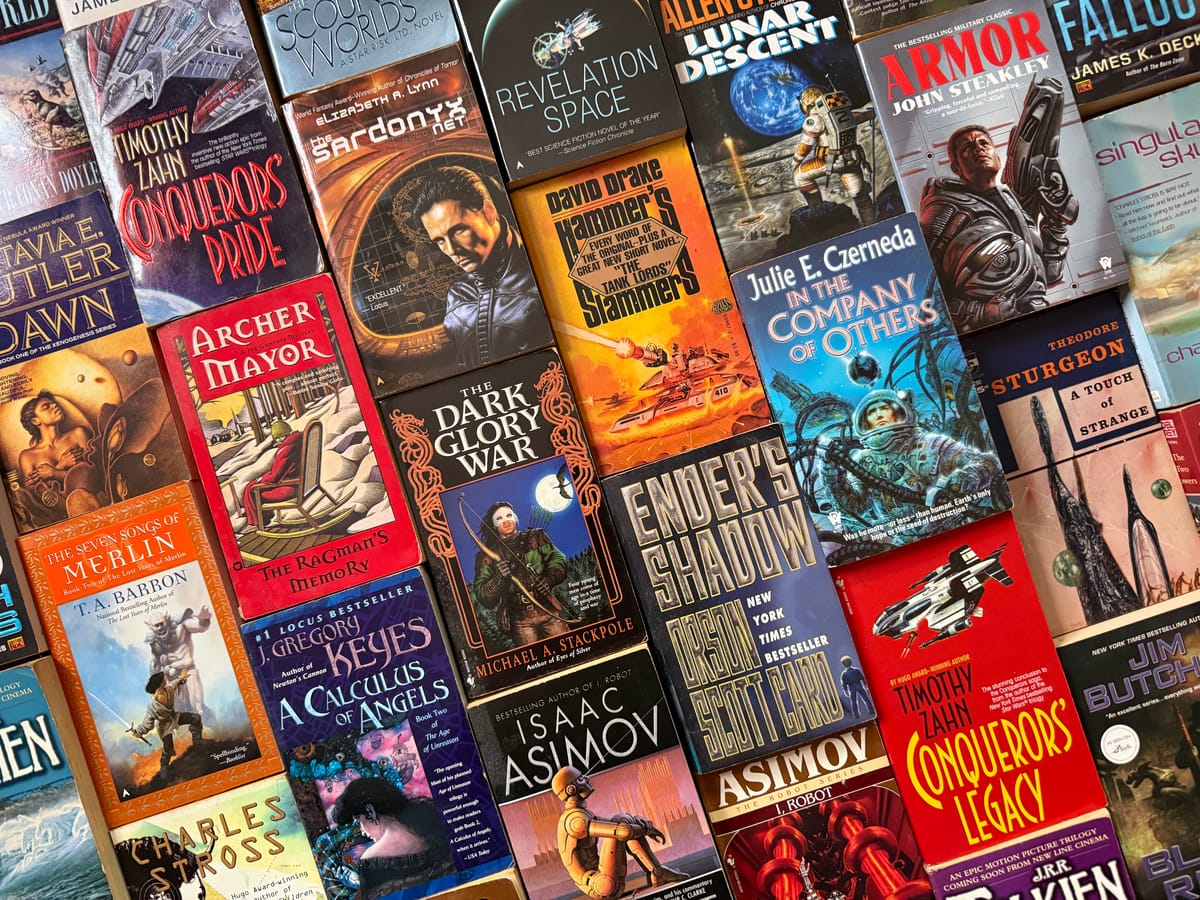
I was never the biggest fan of the mass market paperback as a book format. I always felt that the spines creased a little too easily and that they'd fall apart after too many re-reads. I tended to gravitate towards the larger trade paperbacks and hardcovers when I started buying books: they were always a little more comfortable for me to read.
That said, when I really started getting into science fiction and fantasy as a teenager, it was the mass markets books that I stockpiled. I snagged new Star Wars novels as they came out – often debuting directly as mass market paperbacks, and one of my favorite bookstores was the long-since-shuttered Yankee Paperback Exchange in Montpelier, a cramped little store whose shelves were loaded down with them, and as a bookseller at Walden Books, we swapped out plenty of them with newer one every week, tearing off the cover and tossing them into the dumpster.
That was the appeal of the format: a hand-sized book that was easy to stash in a purse or pocket, all for around $5.99.
After decades, the format is apparently coming to an end: Publishers Weekly reports that as sales have plunged, the few remaining key distributors will no longer support them. It’s a loss for the reading public, because it means that it’ll be even harder for publishers to justify publishing new titles, and for authors to make a living.
As a format, the paperback book was an enormous step forward for the advancement of literacy and the publishing industry in the 20th century. For centuries, books had been handcrafted, luxury items, requiring careful work to sew a binding.
Writing in The Book: A Cover-to Cover Exploration of the Most Powerful Object of Our Time, Keith Houston notes that it was an innocuous patent filed by bookbinder William Hancock that changed everything: ”over the course of a day or two, a series of coats of ’caoutchouc,’ or rubber, dissolved in a solution of turpentine, were painted over the spine so they seeped into the microscopic crevices between pages and bound the whole thing together as they dried. The spine was finished with a strip of cloth stuck to the final coat of caoutchouc and the completed text block was pasted into a separate cover, or ‘case’ by its endpapers.”
The paperback was born. But it’s not just the technology that led to this new style’s popularity: it was the work of publishers, such as George Routledge and later publisher Albatross Books, and Penguin Book’s Allen Lane, who popularized the format, recognizing that a cheap book would be appealing to travelers and commuters to pass the time while riding to and from work or other travels.
In The Book in Society: An Introduction to Print Culture, Solveig C. Robinson notes that the paperback’s key selling point — its low price — meant that it had a wide appeal beyond the bookstore: Unlike traditional hardcover books, which continued to be sold mainly through bookstores, the new paperback imprints were offered in a wider range of venues, from rail stations to drug stores and grocery stores. Relatively inexpensive, the ship, and often issued and series, paperbacks quickly took their place on the store shelves besides magazines.”
In the post-WWII era of mass-consumption, this widespread availability helped build the publishing industry we know today: publishers and imprints dedicated to specific genres such as crime, science fiction, romance, and westerns, sprang up to bring stories to readers across the United States, fueling fandoms and providing authors with enough income to etch out a career as a full time writer.
This world took a hit in the 1970s when a key magazine distributor collapsed, taking with it access to those key store shelves from which so many people could find a cheap book. Robinson notes that in the aftermath, “some publishers decided to make a virtue of the fact that trade paperbacks featured the same size text but at a lower price than hardcover books, and they began to market these books as ‘quality’ paperbacks.”
In Merchants of Culture: The Publishing Business in the Twenty-First Century, John B. Thompson dug into this point quoting an executive from the time: “The hardcover side was snobby, literary, pretentious, tweedy— all things that you would expect from the [1960s]. And the paperback business was sort of second class – we got the books a year later, we got no credit for the words, we were all about marketing, packaging, distributing, and selling books… While the paperback business was dependent on the hardcover business for product, the hardcover houses depended heavily on royalty income from paperback sales to run their businesses.”
Fast forward to the 2000s, and mass market paperback sales continued to drop. The elimination of those key sales channels, the rise of new formats like eBooks and audiobooks, and the continued focus on hardcovers and trade paperbacks took their toll. It’s spelled real problems for authors: where they might before be able to depend on an initial hardcover release and subsequent mass market paperback release a year later— the hardcover sales fueled by libraries and dedicated readers and the greater paperback sales from more casual readers — the shrinking of the category has meant that those back-list sales were no longer as reliable. eBooks have taken up some of the slack, but it isn’t a perfect replacement. And as hardcover and trade paperback book costs have risen — now often in the $30-$45 range — the economic pressure for an author’s book to succeed is higher than ever.
There’s a simple truth here that I feel the larger publishing industry has forgotten: if you make cheap books, you will bring in more readers.
This is the real tragedy that the loss of the mass market paperbacks from store shelves means for the reading public: there are fewer opportunities to buy stories from new authors, and fewer places for people to encounter books in their everyday lives. Grocery stores will still sometimes stock some of the biggest titles — your John Grishams, James Pattersons, and Nora Roberts — but those spaces have continued to shrink, while the bookstores you find at airports, malls, and shopping centers largely devote all of their space to the more expensive trade paperbacks and hardcovers. eBooks can be cheaper, but they’re now a product with considerable friction to use: you need a smartphone or dedicated eBook reader, which are far more than an impulse buy at your local shop.
All of this means a more challenging environment for authors, publishers, and readers, and it means that we’ll see fewer opportunities for authors to publish, for new voices to thrive, and for readers to be enriched. I have a sneaking feeling that there’s a reason why the larger Little Free Library movement has taken off, and why you see plenty used books piling up at library sales, thrift and discount stores, and other places: they’re places for people to find books cheaply, readers who’ve thrown up their hands at the costs that they see at indie and chain bookstores, and who’re essentially removing themselves from the marketplace.
None of this, I feel, is healthy for the publishing industry as a whole: companies need to take a much larger and longer view of the state of reading culture is, and find ways to support it and the authors they publish. Otherwise, I fear that we’ll increasingly find ourselves in a world where only a small and select cohort make their way to bookstore shelves: the ones who’ve gotten lucky with a debut novel or a trend, the proven sellers who’ve dominated the field for decades, or the ones with connections and clout who’re already famous in other places. None of that is great for a diverse and thriving field, and I hope that this latest development isn’t the latest sign of a mass extinction event in the field.